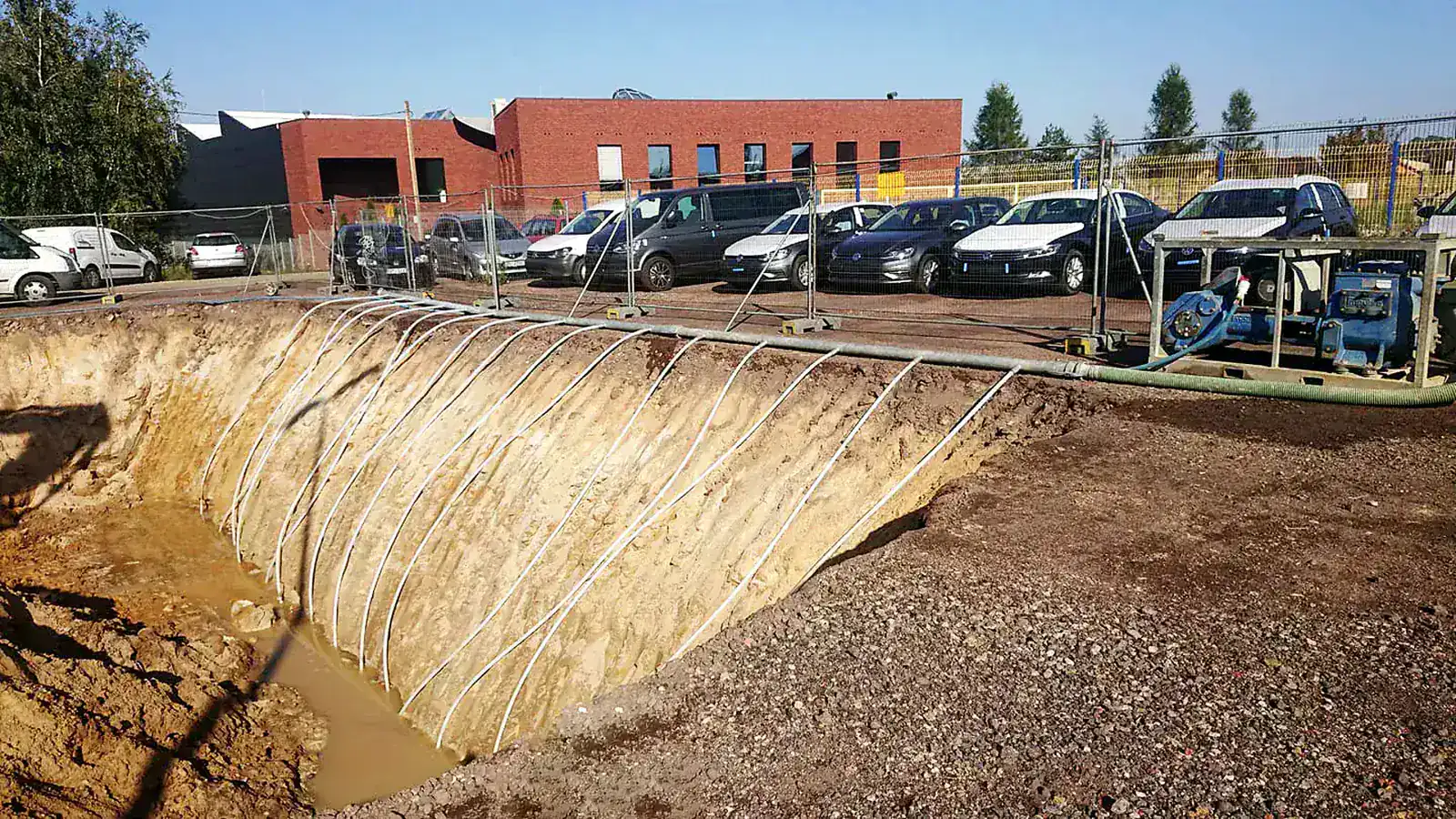
- When is dewatering an excavation necessary?
- Whenever the excavation floor sits below the groundwater table. On site you see it as water seeping from the slopes, a soft, “pumping” floor, and slumping excavation walls. In those conditions foundation works and pipe laying cannot be carried out safely.
- How far can wellpoints lower the groundwater?
- One stage of wellpoints typically lowers the water table by about 4–5 m below the level the pump stands at — at most 5–6 m, because suction lift allows no more. Deeper excavations use further stages of the installation or deep wells. The actual figure depends on the soil type and its permeability.
- How much does dewatering an excavation cost?
- We do not publish a price list, because every site is different — the cost depends on the method, the length of the installation, the running time, the type of drive and transport. We give a specific quote after talking through the conditions on site. Prepare the information listed above and you will have it sooner.
- Do the pumps run without stopping?
- Yes. A dewatering installation has to run continuously for as long as work goes on below the water table — a break means the water rises in the excavation again. Our piston pumps are built to run 24 hours a day.
- Do you serve sites across the whole of Poland?
- Yes. Our equipment yard is in Opole, but we have worked in every voivodeship. Transport of the equipment to site and its collection are arranged for a fee — with our own transport or through a forwarding company.
- Can wellpoints pump out a flooded excavation?
- Wellpoints lower the groundwater around the excavation — ideally before the works go below the water table. Water already standing in the excavation, rainwater for instance, is removed with submersible pumps; after that the wellpoint installation keeps the excavation dry.
- How long does it take to lower the water level?
- It depends on the ground, the depth and the amount of water: in permeable ground the water table drops faster, in fine-grained soils more slowly. That is why pumping starts ahead of time, before the works go below the water level.
- Does excavation dewatering need a water-law permit?
- As a rule a water-law notification is enough: permanent dewatering of construction excavations and discharging water from them require one (art. 394(1) points 5 and 8 of the Water Law). A permit is needed among other things for long-term lowering of the groundwater table (art. 389 point 3). More in the paperwork section above.